
Underwater Breathing Tubes: Are they safe?
A new wave of cheap breathing tubes pose yet more safety dangers for recreational water lovers
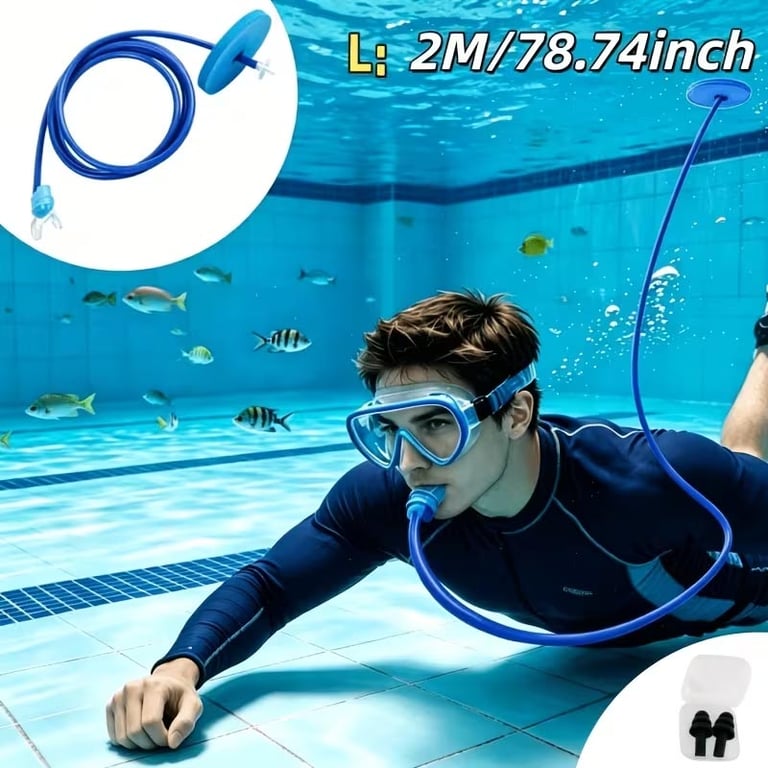

Google the term 'underwater breathing tube' and you'll be presented with an array of breathing tubes available on cheap sites like Temu, Shein and Fruugo, modelled by (AI-created) people seemingly having a great time underwater, aided by a plastic mask and a piece of hose that's attached to a floating buoy.
Seems like a cheap and simple way to breathe underwater, right? You put one end in your mouth, the other end stays above the water's surface, and instead of breathing through a traditional snorkel, you're just breathing through a longer hose while you swim.
Basic physics says otherwise. Critically, the human body is not designed to breathe through long tubes underwater, making these breathing tubes extremely dangerous. And anyone can pick one up for under $15.
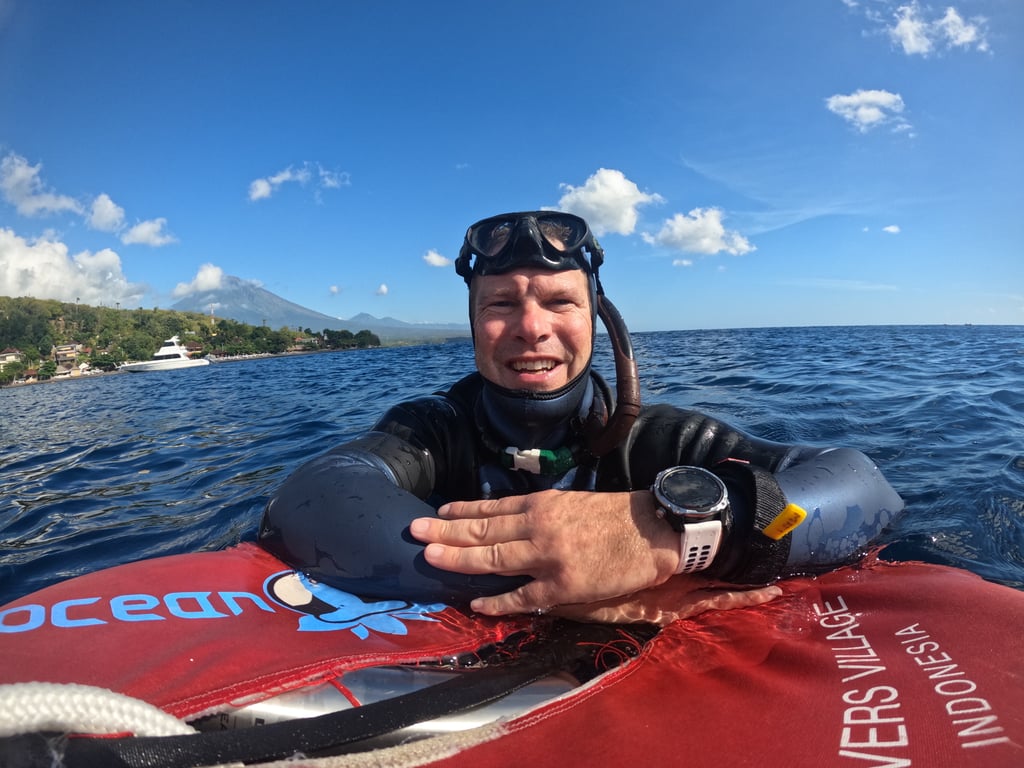
"Simply - it wouldn't work," says Spearfishing NZ President Rob Harrison. "And the reason it doesn't work is the same reason as snorkels are the length they are. And snorkels are not designed as devices for breathing underwater. It's a device for keeping your face in the water while your head stays at the surface. That distinction is the entire product."
Why won't it work?
As most divers know, breathing underwater is a high-risk activity. "Once your chest is below the surface, the water presses in on it while the air in the tube is still at atmospheric pressure," explains Rob. "Your breathing muscles have to make up the difference. At one metre down, that difference is roughly the maximum a fit adult can generate in a single all-out effort.
"This tube is two metres. So at full stretch, you are asking your diaphragm for about twice what it can produce, on every breath, indefinitely."
How come I can buy one then?
It's easy to assume that because something is for sale, it must have been tested and approved. Sadly, that's not always the case. Products sold through online marketplaces can come from many different manufacturers, all operating under different regulatory systems. Using unsafe equipment to provide you with an air supply deserves some thought - would you really want your life - or your kids' lives - to be decided by equipment that hasn't been designed, tested and intended for the environment in which they are being used?
Why are they dangerous?
There are many similarities here to the full face mask story we published on Dive Pacific earlier this year, highlighting the dangers of buying cheap, untested products. "It's a product that promises to remove a skill barrier, which in this case is holding your breath, for less than the price of a lunch," says Rob. It's not tested or certified, and if it hurts someone, there's no manufacturer to answer for it."
Think about the 'milkshake test'," says Rob. "If you tape two straws together to reach a thick shake, the sucking gets harder. If you add a third straw, you can't get your milkshake no matter how hard you pull.
"Now run that experiment with someone kneeling on your chest, and you have a fair idea of how this breathing tube works at two metres."
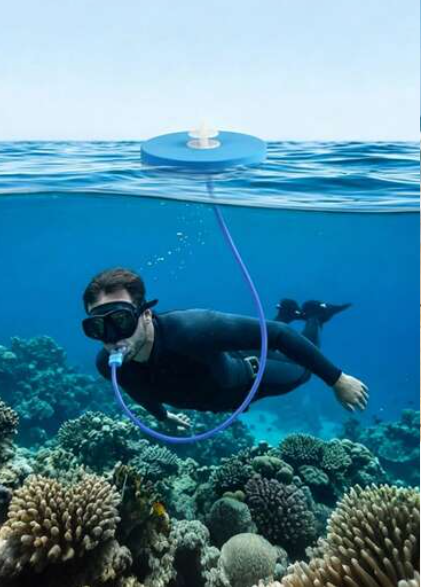
There are untold risks with this product, which is advertised alongside shots of it being used in swimming pools and in the ocean. These include:
The squeeze. Pulling hard against a high resistance airway while immersed drops the pressure inside your chest and can cause tears in the lungs and can draw fluid into the lungs. That's immersion pulmonary oedema. It's real, it's documented in swimmers and freedivers, it shows up as breathlessness and a cough that can turn pink and frothy, and it can be fatal. This device is close to a purpose built machine for causing it.
Dead space. Every breath you push out sits in the tube, and it's the first thing you breathe back in. At two metres, the tube holds several times a normal breath, so you are essentially breathing your own exhaust. CO2 climbs, and your body responds by breathing faster and shallower, which only ventilates the tube. That loop tightens on itself. Rising CO2 brings headache, confusion, air hunger and panic, and it reaches your judgement before it reaches your body.
Resistance. Airflow resistance rises with tube length and with the fourth power of the bore. Halve the internal diameter and breathing gets sixteen times harder. Cheap tube, narrow bore, two metre run.
Blockage. The floating intake can easily become submerged by waves, kinked or blocked.
full face mask story Something goes wrong underwater, and you won't know about it until you're already in trouble. There's also no backup air source.
Breathing through this hose can also lead people to believe they can dive deeper because they have access to air - something which isn't the case due to the increased water pressure.
"A standard snorkel caps length at 38cm and internal volume at about 230cc for adults," explains Rob. "Those numbers are not arbitrary. These breathing tubes are more than five times the permitted length."
I'm just looking for a cheap solution for kids...
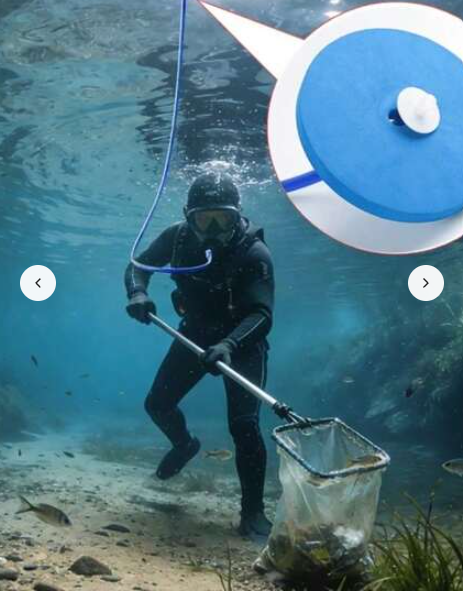
These tubes are worst for children. They have weaker breathing muscles, smaller breaths and prooportionally far more rebreathed air," tells Rob. "But it's important to note that there is no age or fitness level at which these are a good idea."
Where do I get good equipment?
"I suggest buying training before you buy gear," says Rob. "A course teaches the two things no equipment can: how deep you can actually go, and how to rescue the person you're diving with."
Knowing what equipment is safe and what isn't is becoming increasingly difficult. However, it's fair to say that if you're buying your diving safety equipment from an online website for a few dollars, the chances are extremely high that it's untested and unsafe.
When buying underwater equipment, look for the following:
- Equipment that adheres to recognised international standards;
- Equipment sold by established dive clubs and stores;
- Equipment that comes with clear instructions, limitations and safety warnings;
- Proof of independent testing.
Basic rules
Whatever equipment you're using, there are some simple rules that apply wherever you are.
- Get training first
- Never dive alone
- Use the right gear: a mask that fits your face, a plain J-shaped snorkel with no valves or gadgets, fins suited to your ability (not ambition), a rubber weight belt with a quick release, and a float and dive flag.
- Join a club. There are heaps of dive and spearfishing clubs in New Zealand where you'll meet people who can teach you what the internet can't.