
Sound in the Silence
Know how to speak - and hear - clearly underwater
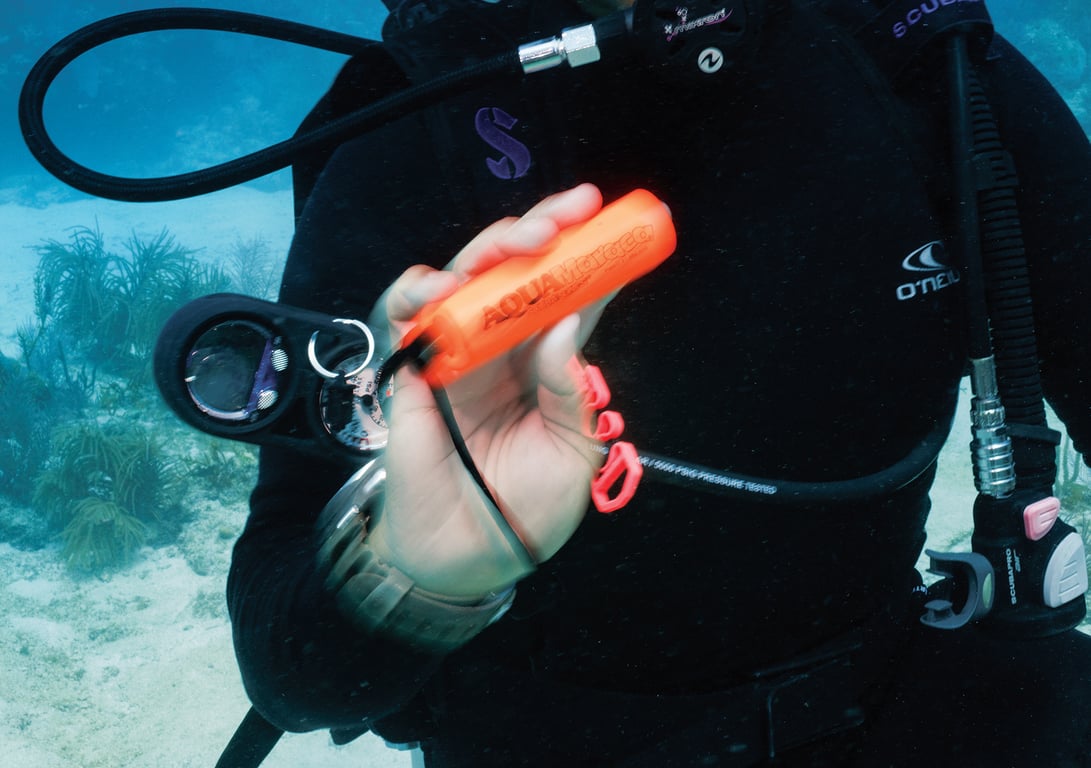

Many divers slip below the surface to get away from the hustle, bustle and noise of everyday life. They enjoy the quiet serenity of being underwater and hearing only their bubbles. As divers know, the most efficient way to communicate is with various hand signals that indicate ascent and descent or are silent substitutes for speaking “OK” or “Something’s wrong,” for example.
The major drawback with hand signals or any visual communication system is that you must have line of sight to see what others are expressing to you. Audible communication and cues do not have that restriction. If we are in range, we can hear what is going on and don’t need something in our field of view to get our attention.
When we hear a sound on land, we can determine the location of its source relative to us, and approximate its distance away, fairly accurately. Sound waves hit one ear before they hit the other, and with that difference of just milliseconds, our ears and brain work together to triangulate the sound waves. Our brains then process that information to give us direction and distance.
Sound travels more than four times faster underwater than in air. Water is a denser medium than air, so its mechanical properties make sound waves propagate faster. Our ears and brain aren’t used to processing the shorter duration between when each ear perceives the sound wave. So while we can still hear the sound, we have a more difficult time determining where and how far away that sound originated.
A tank banger is one of many ways to create audible cues and alert your buddy or other divers to a problem or hazard. While many divers cherish the peace and quiet underwater, sometimes circumstances require us to get our buddy’s attention. You may want to show them something you found or alert them to a hazard or another object of which they may not be aware. Sometimes you need to get someone else’s attention, such as a first-time student who is so enthralled with their new environment that they aren’t paying attention to the instructor.

An audible attention-getter can be as simple as making a fist with one hand and slapping it against the open palm of your other hand. The noise could be enough to get other divers’ attention. Audible signalling devices are also commercially available. A tank banger is a hard plastic ball you attach to your cylinder with a bungee or silicone strap, much like a giant rubber band. You can grab the ball and release it to make a significant noise as it hits the cylinder.
Handheld noisemakers are small, sealed tubes, usually metal, with a hard object inside that rattles when you shake the tube. Another device attaches to your inflator hose between the hose and the inflator on your buoyancy compensator. It is sometimes called a 'honker' or 'duck' because it sounds like a loud duck when activated underwater. Divers can use other devices beyond these commonly-used examples to get someone’s attention.
Banging a weight or other heavy object against a boat hull is just one way the surface crew can signal divers to do something based on the briefing instructions.
Sometimes a dive operator needs a recall system to get the attention of all the divers in a group and to get them to the surface and back on the boat as quickly and safely as possible. The emergency could be due to an accident with another diver or a sudden and drastic change in weather.
Some dive boats have a sophisticated electronic recall system. The operator can lower a submersible speaker into the water and activate it to generate a loud sound that alerts the divers to begin their ascent. Some operators may have a different system, such as banging a weight on the side of the boat or the ladder, while others will leave the propellers in neutral and rev the engine to generate enough noise to signal divers. The boat operator should brief their divers about the recall signal and the procedures to follow when hearing it.
Divers should always be alert to other audible cues around them. While you may not be able to immediately determine the sound’s location or distance, once you are aware of an audible cue, you will know to look around, see what is going on and act accordingly.
Some common audible cues that divers may perceive are a diver yelling through their regulator or a sudden change in breathing patterns from a buddy behind you. Hearing an increase or decrease in respirations through the regulator may indicate a diver in distress.
Audible cues and signals can get your buddy’s attention, signal a group of divers or indicate a problem you can help address. Even though we may dive to escape the noise of everyday life, we need to pay attention to the sounds around us. Doing so could make your dive even more special because your buddy got your attention to see something remarkable — or you may even save a life.
For more diving safety information visit World.DAN.org
Read more from
DAN World
Divers Alert Network (DAN) is the world’s most recognised and respected dive safety organisation, having remained committed to the health and well-being of divers for 40+ years.