
Professor Simon Mitchell honoured with NOGI award
Kiwi one of five recipients recognised for services to underwater


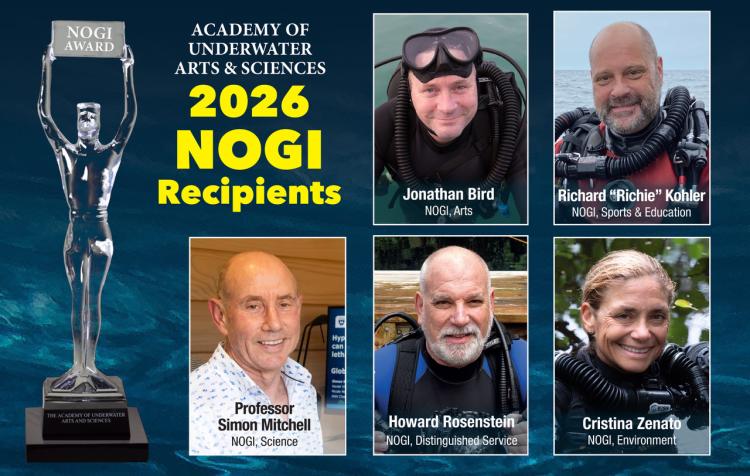
Professor Simon Mitchell has received the NOGI Science award from the Academy of Underwater Arts and Sciences (AUAS) for his research in diving medicine.
First presented in 1960m and widely considered to be the 'Oscars' of the diving world, the NOGI Awards are presented annually to diving luminaries who have made a global impact on diving across four categories: Science, Arts, Sports/Education and Environment. A fifth NOGI is given for Distinguished Service. The NOGI Awards recognise individuals who have made significant career contributions to the sport, the industry and the world.
"Being awarded a NOGI was very special; it's a very validating moment, not just for me, but for the team I work with," Mitchell says. "Good research takes money, and a very good team, and I am lucky enough to have an outstanding group of people around me who do the majority of the work on the ground. It's a truism that as your career advances you become more of a leader than a doer, which is the case with us too. I have a couple of PhD colleagues from the Netherlands I work with who are two of the most productive and brilliant team members I could possibly have. They deserve a lot of credit too."
A regular contributor to Dive Pacific, Professor Simon Mitchell is an anaesthesiologist at Auckland City Hospital, a diving physician at Auckland's North Shore Hospital, and is Professor of Anaesthesiology at the University of Auckland. He has been Editor-in-Chief of Diving and Hyperbaric Medicine Journal since 2019.
Mitchell is internationally recognised for his research in diving medicine, particularly in decompression physiology and oxygen toxicity. A prolific author and speaker, he has travelled to over 40 international meetings as a fully-funded invited speaker in the past five years (excluding 2020 - 2022). He has also participated in extreme technical diving expeditions, including cave diving and deep wreck diving - the latter of which includes a four-hour world record dive in May 2002 to the wreck of the SS Kyogle, an Australian freighter sunk during bombing practice on May 12 1951.
First rebreather dive using hydrogen
In 2023, Mitchell worked with fellow anaesthesiologist and diver Dr. Richard 'Harry' Harris on the first-ever hydrogen rebreather dive to a depth of 230m. The 16-hour dive - which took almost two years to plan - was a field test to determine whether it's possible to use hydrogen to improve safety and performance on very deep tech dives. A significant challenge to deep diving is an increased pressure, and CO2 buildup as breathing gas becomes more dense at greater depths, which can lead to fatal respiratory failure, inert gas narcosis and oxygen toxicity.
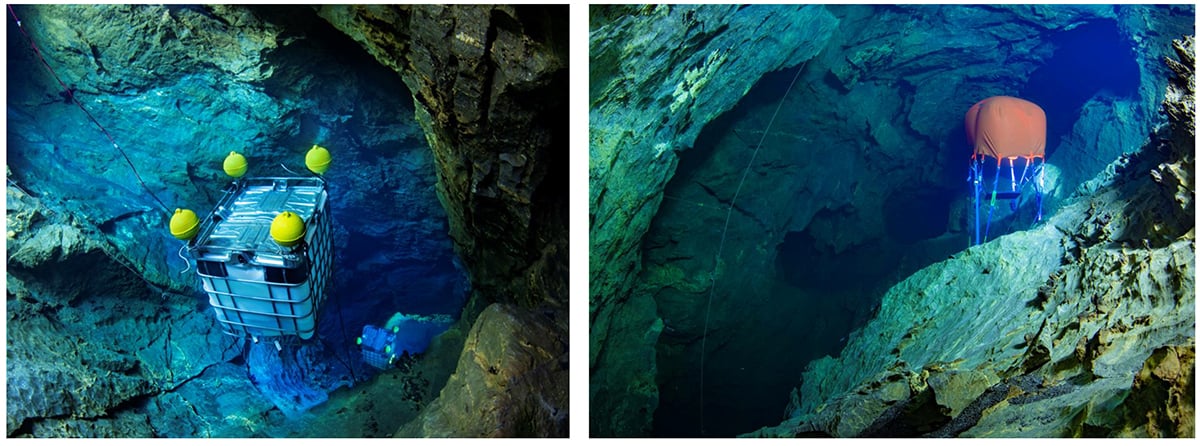
That technically complex dive is the subject of Deeper, which follows Harris - one of the heroes of the Thai Tham Luang cave rescue - as he attempts to enter an uncharted section of Pearse Resurgence in New Zealand, using hydrogen to overcome the effects on the body that make such depths extremely dangerous. Deeper records the lead-up to Harris' attempt, and will be available on streaming platforms in New Zealand in February 2026.
The team at the New Zealand Underwater Association and Dive Pacific extend our warmest congratulations to Professor Mitchell and the individuals who together have shaped modern diving, underwater exploration and ocean stewardship.
Other recipients
Arts: Jonathan Bird. Award-winning underwater cinematographer Bird has won eight Emmy awards for his work. Over his career, he has filmed over 50 documentaries for major broadcasters, and has over a million subscribers on his YouTube channel, BlueWorld TV.
Sports & Education: Richard 'Ritchie' Kohler. Veteran shipwreck explorer and filmmaker Kohler has played a central role in bringing underwater history to mainstream audiences, combining technical diving with human-centred storytelling.
Environment: Cristina Zenato. Shark behaviourist, cave explorer and conservation advocate Zenato has worked extensively in the Bahamas, leading efforts that resulted in full shark protection in 2011. She has also contributed to global campaigns reducing shark fin consumption.
Distinguished Service: Howard Rosenstein. A pioneer of dive tourism in the Mediterranean, Red Sea and Indian Ocean, Rosenstein played a key role in opening destinations like the Red Sea and the Seychelles to divers while advocating for conservation. He was also instrumental in establishing Ras Mohammed as Egypt's first nature reserve.