
Book review: Captain's Dinner
A murder at sea changes legal history forever
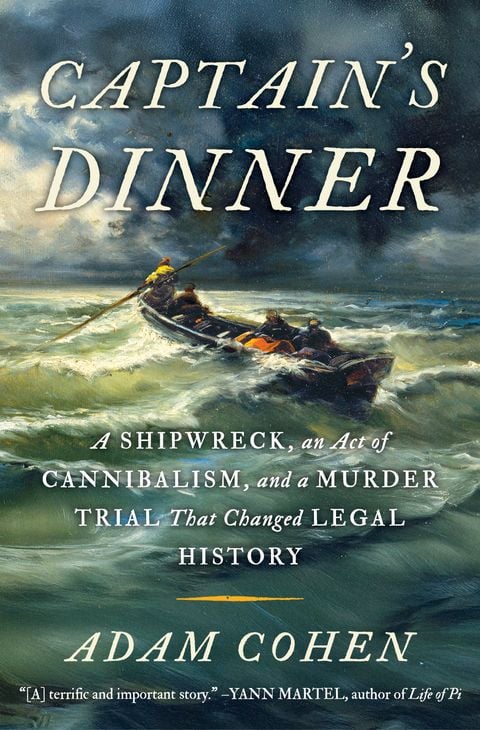

If you like your stories based in history, with a solid extra helping of philosophy, and a side salad of law thrown in, Captain's Dinner might be a book to add to your reading list.
Is killing one person justified if it saves the lives of three others?
That's the question posed in New York Times bestselling author and former lawyer Adam Cohen's latest book, Captain's Dinner. In a tale based on a true story, on May 19th, 1884, the yacht Mignonette, owned by a rich Australian, sailed from England en route to Australia by four crew, on what should have been a routine voyage. Instead, the boat sinks in the Atlantic, and Captain Thomas Dudley and his crew all find themselves adrift in a tiny lifeboat with no water, very little food, and no hope, unless they are somehow miraculously found by a passing ship.
After three weeks at sea, Captain Dudley makes the decision that they will sacrifice the 17-year-old cabin boy, Richard Parker - the sickest of the four - to save the others. The older crew members kill and eat Parker to survive.
When they are rescued, and return to England, they admit eating Parker, expecting their decision under the old maritime 'custom of the sea' rules - that survivors draw lots to see which crewmate will be sacrificed. The crew thought this despite not actually following that rule - Dudley argued that he couldn't get his mates to go along with it. (Cohen has said that during his research for the book, he discovered that even when lots were drawn after shipwrecks, somehow it usually always ended up being the cabin boy, or the one Black person, or Spaniard, on a boat full of British sailors.)
However, when they admit their decision, the remaining crew members are put on trial for murder.
Their decision to sacrifice Parker ignited a storm of controversy, and their trial became a landmark case that established the legal precedent that necessity cannot justify murder.
What happened aboard that lifeboat during those weeks, and the legal consequences that follow, form the basis of this haunting, and gruesome book - one which is definitely not for the faint-hearted, as Cohen describes some of the cannibalism scenes in vivid detail.
Fascinating in subject, although perhaps a little drawn out at times, this is a macabre story that if nothing else, will get you thinking - and on occasion, feeling a little unwell. Ultimately, this story of Victorian tragedy questions that enduring moral conflict: how far would you go to stay alive?